The book’s introduction and the chapter “Elevating your radio magic”, in full.
Introduction
“This trick is one that I performed over the radio. Yes, over the radio. 500 people called in to say that they couldn’t see how it was done.”— David Ginn
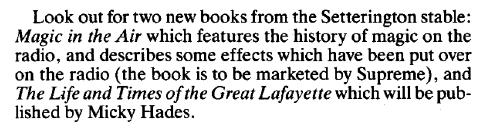
I started researching radio magic in February 2023. Reviewing back issues of The Magic Circle’s magazine The Magic Circular, I found a brief mention, in 1988,1 of two upcoming books by Arthur Setterington.
Arthur passed away in 2006. ‘The Life and Times of the Great Lafayette’ was published in 1991, but the radio magic book did not appear in web searches.
I asked around a few knowledgeable people, including specialist magic booksellers John Hinchliffe and Philip David Treece. They had never heard of the book.
Knowing that Arthur was heavily involved with the Hull Magicians’ Circle for over sixty years, I emailed them to ask if any members knew anything about the book.
I struck gold.
Arthur’s friend Jon Marshall confirmed that the book had never been published but that he had the manuscript.
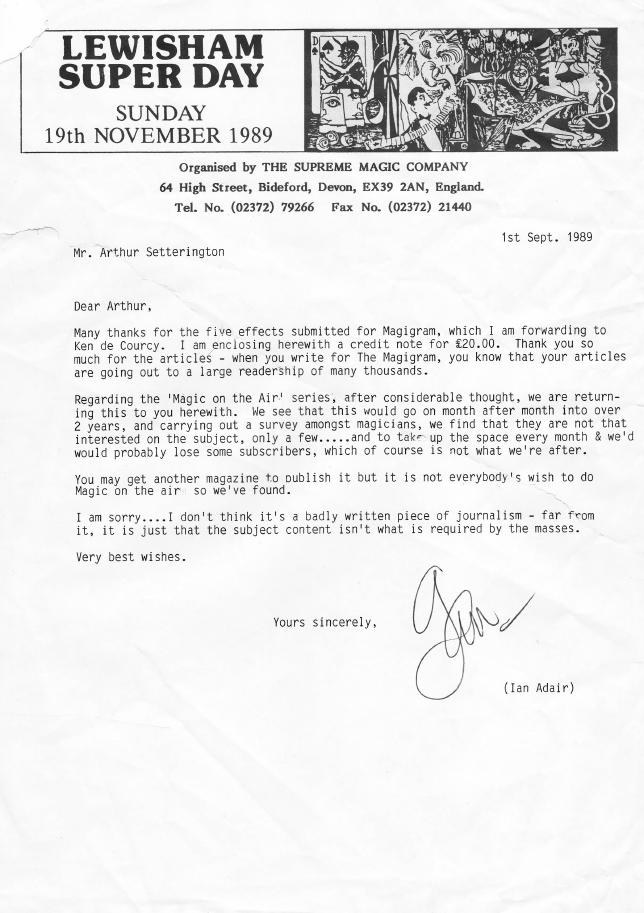
Accompanying the document, which Ken de Courcy had illustrated, was a letter from the General Manager of Supreme Magic Co, Ian Adair, rejecting the manuscript for publication in their magazine ‘The Magigram’:
“Regarding the ‘Magic on the Air’ series, after considerable thought, we are returning this to you herewith. We see that this would go on month after month into over 2 years, and carrying out a survey amongst magicians, we find that they are not that interested on the subject, only a few…… and to take up the space every month & we’d probably lose some subscribers, which of course is not what we’re after.
You may get another magazine to publish it but it is not everybody’s wish to do Magic on the air so we’ve found.
I am sorry…. I don’t think it’s a badly written piece of journalism – far from it, it is just that the subject content isn’t what is required by the masses.”
The letter had been torn in half.
In this volume, I’ve combined my research into radio magic with Arthur’s original thoughts.
Arthur’s aim, and now mine, has been to look closely at the many possibilities offered to magicians through appearances on radio and for this purpose to:
Trace the history of radio magic, looking at the programmes, methods and presentation of some of the leading exponents of radio magic.
Provide ideas and material for talks, interviews, and sketches. In some cases, original scripts used in actual broadcasts are included.
Describe in detail the presentation of magical effects for radio, including a number of new effects especially adapted to this medium.
I hope you enjoy reading our combined work, and find it useful in creating effects for radio, podcasts, and ZOOM shows.
In the meantime, thank you for not being one of the masses.
Ian Fenn, May 2024
Ian Adair’s letter to Arthur, rejecting ‘Magic on the air.’ Courtesy of Jon Marshall.
1. Magic Circular May/June 1988 Vol. 82 No. 886. “This is Your Life” for Arthur Setterington. ↩
Elevating your radio magic
The previous chapter offered some food for thought regarding what to consider when creating radio magic, but how can you make your radio magic, well, magical?
Many of the performers listed in the history at the beginning of this book were successful because they took advantage of the following principles.
Lesson 1: Make pictures
Radio “is a blind medium but one that can stimulate the imagination so that as soon as a voice is heard, the listener attempts to visualise the source of the sound and to create in the mind’s eye the owner of the voice… Unlike television, where the pictures are limited by the size of the screen, radio’s pictures are any size you care to make them (Mcleish & Link, 2016).”
Albert Daniels clearly understood this. He demonstrated that radio magic is possible if the performer is engaging and if the listener has enough information to form their own picture. That’s as true today as it was in 1925.
As Eugene Burger wrote in a 1995 issue of Genii, “I remember many childhood evenings sitting utterly transfixed listening to radio mystery stories and becoming really frightened. My fear was not simply the result of the radio presentation but also of my involvement with the story—my own imaginative involvement—filling in the story’s details in my own mind… Radio exercises our imagination as we create our own individual inner pictures for the stories.” (Burger, 1995).
Present in the few recordings of David Berglas that exist is his technique of explaining the impossibility of what he is doing. “When most magicians do something, they haven’t built it up enough to create an atmosphere. But if you more or less tell the audience what you’re going to do, their brain starts thinking, ‘Well, that’s not possible.’ And when you actually do it, you obviously get more applause than if you had just done it without saying a thing.”
Berglas also reminds people what he has just done. “Most magicians go on to the next trick. They want to show off how many tricks they can do. But I’m the opposite. When they say, ‘Do another trick,’ I say, ‘No. You haven’t finished thinking about the last one.’ I want people to understand the impossibility of what I’ve just done. So that it makes a big impression. The more time they have to think, the more impossible it gets.”
The making of pictures shouldn’t begin and end with speech. Contributing to a Facebook group discussion of radio magic, mindreader and radio producer Chris Cox said, “As a producer at Radio 1 for years, I can tell you the main things are making it SOUND magical. Making sure everyone who is listening understands what is happening. The last thing I want as a producer is a magician doing something where the DJ just has to keep explaining what they’ve seen, e.g. the cards just change places… the coin just went in the can.” (Cox, 2017).
Since Cecil Lyle’s initial presentation, sawing someone in half has proved to be a popular choice for sound-only presentation. Robert Harbin (Harbin, 1954), Robert Knight (Goodliffe, 1966), Donald Chambers (Aldridge, 1973), Jack Delvin (Field, 2010), John Wade (Wade, 1977), and Scott Penrose (The Magic Circular, 2009) are among those who have performed the illusion on the radio.
Lyle’s presentation is notable as it represents the first time a specific effect was chosen for its effectiveness on air, with a microphone placed for maximum effect. But even that can be taken a step further.
The purposeful use of sound was central to David Berglas’s radio work: darts landing on a board, a brooch rattling in a box, a coin rattling in a bottle, drilling into wood, or the pop of many balloons. When using two studios, he also had the microphones set to ensure that the two studios sounded very different from one another. When he switched places with Dickie Valentine, listeners could hear Dickie’s voice change to suit the second location as he counted down (Berglas, 2023).
Berglas believed that these sounds would help listeners create their own vivid pictures. 97-year-old Berglas said in 2023, “It’s not enough to describe something and hope listeners take your word for it. You might as well say, ‘I’ve just popped up to the moon, looked around, and returned. You don’t want to describe something. You want listeners to experience it.”
Engaging the theatre audience was also important to Berglas. He considered it an important element for listeners at home. “If you have an audience there, their murmur, their laughs and gasps, confirm what you’ve just said or described, If I’d been in the studio without an audience, I could have just said anything, but the audience by applauding or laughing confirmed what I was saying was true.”
Lesson 2: Speak to the individual
The use of “You” throughout the Cyril Shields book “Broadcast Conjuring Tricks” is potentially significant, as was the cheeky suggestion to remove parents from the room before “The Children’s Hour” broadcast.
Radio is a direct and personal medium. Skilled broadcasters know that they are usually speaking directly to the listener - as if they are talking to a single person over a cup of coffee or a pint of beer. Shields and the programme-makers supporting him clearly knew this. If you wish to connect with listeners, follow their approach — talk to the individual, not the crowd.
Lesson 3: Break boundaries
When David Berglas wasn’t purposefully using sound, he often took advantage of radio’s ability to shrink distance, seemingly changing the physical world to match. Brooches, marked treasury notes, passports, and pop stars would move from one physical location to another, apparently at the speed of sound. Nothing was too big or small for Berglas to move or transpose.
Only a few cherished and popular performers would likely get away today with the amount of process involved in Sirdani’s effect for Atlantic Spotlight. The main procedure takes too long and audience interest would wain. However, the characteristic of radio he exploited — the ability to span tremendous distances instantaneously — is one that today’s magicians can consider exploiting. As John Wade demonstrated with a banana, even the simplest trick can reach miracle status if the action happens thousands of miles or even a corridor away from the performer.
Lesson 4: Eliminate the boring
Maurice Fogel’s broadcast is notable for introducing the principle we know as “pre-show” to radio for the first time. As a medium, radio lacks space. Every single word or sound counts. So, the collection of information or the completion of boring tasks before a show begins is easily justified in radio, where economy and speed are key.
David Berglas often completed steps before recording started, even if he was only lining up some audience members in front of the stage ready for a routine.
However, there are risks with “secretive” pre-show. YouTube has several clips of the Israeli mentalist Lior Suchard being exposed. In one, he asks a radio presenter, “Did you ever tell me the name?”, only for the presenter to reply, “Yes, I wrote it down.” (“Mentalist Lior Suchard exposed on Radio”, 2018).
The answer may be to adopt the approach of Marc Paul. “I believe that for pre-show to be effective we have to be honest and tell our audiences about what happened before the show. We can still use double speak but the impression (no pun intended) left on the audience is that they have been informed of what happened and feel that nothing is being concealed. (Paul, 2003)”
Another way of optimising airtime or “eliminating the boring” is to pre-arrange participants. The use of pre-arranged judges in “The Piddingtons” was a masterstroke for several reasons:
No awkward silences while audience volunteers are found.
The judges know how to behave on air, meaning that the magician avoids the issue of guests talking too much that Jasper Maskelyne appeared to face in his 1932 transmission.
Pre-show work can easily be completed with the judges before a broadcast. (The Piddingtons did this.)
If judges are respected members of the local community or well-known celebrities, the audience will be more interested. Trust is also implied.
Using multiple judges also delivers a variety of voices.
Today’s conjurers can also arrange a judge or similar, even if it’s someone from the newsroom, station management or sales. Often, the presenter isn’t the best choice to do a trick on because they will be distracted by other responsibilities, such as when to break into the next traffic bulletin.
Lesson 5: Break through the background
Radio is a less demanding medium than others. The audience can choose to do other tasks while listening. The use of sound and silence can be used to break through. The Piddingtons were masters at this. When they sounded their gong, you knew something amazing was likely to happen.
Lesson 6: Surprise
Lack of vision means radio can surprise like no other medium. The following excerpt from “Hancock’s Half Hour: The Conjurer” provides a good example. It is difficult in any other medium.
In the scene, Hancock and his cast have just escaped from prison after entering a magician’s cabinet (“Hancock’s Half Hour: The Conjurer”, no date).
[Dogs barking]
Hancock
Faster! The dogs are catching up with us!
[Laughter]
Hancock
Faster!
[Dogs barking]
Bill
What happened Tub? Just as we got out of that tunnel under the stage, they set the dogs on us.
Tony
They think we’re escaping convicts. Faster!
Kenneth
This is most embarrassing for me. Being chased across Dartmoor by bloodhounds.
Hancock
Why?
Kenneth
I’m the Governor.
[Laughter]
[Applause]
In radio magic, the master of surprise has been David Berglas. In “Box over Regent Street”, a prediction suddenly becomes a transposition, and in “DIY”, a failed prediction suddenly becomes correct.
Lesson 7: Consider the performance environment
The Piddingtons had full control over their studio environment and could change it, facilitating their performance. Using novel locations (the diving bell and the stratocruiser) helped listeners visualise Lesley’s challenge. You could hear the bubbles of water as the diving bell submerged and the sound of the engines as the stratocruiser soared.
The modern-day magician may not be able to change their studio environment, but they can aim to understand it before they arrive. They can also, with arrangement, make use of novel locations, either live or via a recording. A benefit of the COVID pandemic is that most radio stations can now put a ZOOM or Skype call live. So, broadcasting from a remote location is now possible, provided an Internet connection can be found.
Bear in mind that many radio stations now post videos to YouTube. So, using the studio furniture to hide a sleight may not be successful. An effect using the “dual reality” principle may also be problematic.
Lesson 8: Interact with listeners
Sydney Piddington was responsive to the listeners. He would read their letters out and shape the performance around them, particularly if it was an opportunity to rule out another idea of trickery. He knew doing this encouraged greater engagement from listeners.
Today’s magicians can be responsive in a way that Sidney couldn’t. Using email, text, social media, instant messaging, and other mechanisms, audience feedback can take minutes rather than days.
Lesson 9: Consider topicality
Where possible, Sydney Piddington attempted to ensure routines were topical. The Melbourne Cup routine is an example. In “DIY”, David Berglas took advantage of a popular craze.
Today’s magicians can also make their routines topical. For example, a routine on local radio featuring local landmarks is likely to be more interesting to listeners than a straight performance of the Brainwave deck.
Lesson 10: Work with somebody else
The second series of The Piddingtons is better than the first. Having a producer who was “in on it” and fully participated in the production made a significant difference. If there is the opportunity to involve radio personnel more deeply, take advantage of it.
Failing that, find somebody to bounce ideas off, just as Berglas did with Tony Corinda.